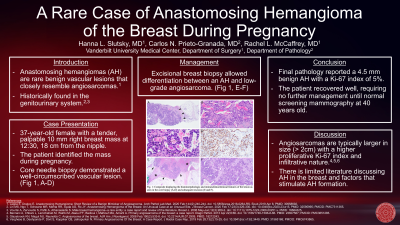
Introduction: Anastomosing hemangiomas (AH) are rare benign vascular lesions that closely resemble angiosarcomas. Historically, AH are found in the genitourinary system; however, they have been reported less frequently in other areas of the body. At this time, there are only two cases of AH reported in the breast. The goal of this case presentation is it help identify distinctions between AH and low-grade angiosarcomas found in the breast as therapeutic management differs significantly between these benign and malignant lesions.
Case Presentation: We report a case of a 37-year-old female who presented with a tender, palpable 10 mm right breast mass at the 12:30 position, 18 cm from the nipple. The patient identified the mass during pregnancy. Core needle biopsy demonstrated a well-circumscribed vascular lesion composed of interconnecting capillary-sized and medium-sized vascular channels, rare fibrin thrombi, hobnailing endothelial cells, and features that suggest extramedullary hematopoiesis. On immunohistochemical staining, cells were immunoreactive for CD31 and ERG and the Ki 67 index was 5%. No atypia, malignant cells, necrosis, or increased mitotic activity were identified. In order to differentiate between an AH and a well-differentiated low-grade angiosarcoma, we proceeded with an excisional breast biopsy. A a 4.5 mm benign AH was reported on final pathology. The patient recovered well, requiring no further management until normal screening mammography at 40 years old.
Discussion: When comparing our presentation of a benign AH, the major differentiation between this benign process and angiosarcoma is the sarcoma is typically larger in size (greater than 2cm), higher proliferative Ki-67 index and its infiltrative nature which causes distortion in the normal breast stroma and lobular architecture. In a case by Varghese et al. an angiosarcoma initially identified as a cavernous capillary hemangioma had a Ki-67 index of 20-40%. This case highlights the importance of defining the proliferative index when differentiating between a benign AH and angiosarcoma. Although AH commonly presents in the genitourinary system, with more recent cases reported in the breast, there continues to be limited literature discussing factors that stimulate AH formation, including pregnancy. Further investigation should be completed to determine any hormonal and extramedullary hematopoietic factors influencing AH formation or growth.