RESIDENT PHYSICIAN Henry Ford Health System, United States
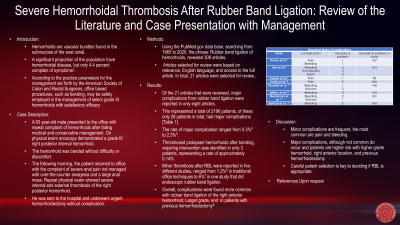
Objectives: According to the practice parameters for the management set forth by the American Society of Colon and Rectal Surgeons, office based procedures, such as banding, may be safely employed in the management of select grade III hemorrhoids with satisfactory efficacy. However, these procedures are not without complication. This is a case description of a severe complication requiring surgical management. Reviewing the literature and management of such complications.
Methods: Using the PubMed.gov data base, searching from 1965 to 2020, the phrase: Rubber band ligation of hemorrhoids, revealed 309 articles. Articles selected for review were based on relevance, English language, and access to the full article. In total, 21 articles were selected for review, only eight of these studies reported major complications after rubber band ligation, requiring hospitalization for further management
Results: The rate of major complication ranged from 0.3%4 to 2.3%5. Thrombosed prolapsed hemorrhoids after banding, requiring intervention and thus being classified as a major complication, was identified in only 3 patients, representing a rate of approximately 0.14%. However, minor thrombosis after rubber band ligation is not all that uncommon, complications of this type were reported in five different studies
Conclusion: Rubber band ligation is a safe, simple, and usually well tolerated office procedure. However, it is not without complications. Severe thrombosis of the internal and external hemorrhoids requiring emergent intervention, while not common, is likely underreported and needs to be recognized as a potential source of morbidity for rubber band ligation